… or ANTI-G COVERALLS
When in flight, the body can have trouble adjusting to stresses produced by rapid changing of speed or direction. In situations such as seat ejection, ditching, or parachute opening shock, the short duration of the excessive force has little effect on the body.
However, changing the direction of flight produces stress forces equal to several times the normal pull of gravity for much longer periods of time. These longer duration forces can have dangerous effects. At 5 g’s (5 times the force of gravity), the aircrewman’s body is exposed to a force that increases its weight 5 times.
This increased weight has many effects. Your body is pushed down into your seat. Your arms and legs feel like lead, and operation of equipment becomes more difficult. The extra weight on your internal organs causes stomach and chest pain. Most important, however, is the effect on your circulatory system. At 5 g’s, your heart cannot pump enough blood to your head. When this happens, you will pass out. Wearing anti-g coveralls will help prevent this from happening.
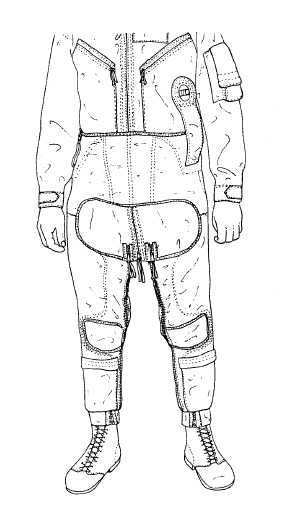
The Navy uses two models of anti-g coveralls (commonly called « G » suits). These coveralls provide protection against blacking out, loss of vision, and lowered mental efficiency caused by high g-forces experienced in high-performance aircraft. Figure 11-4 shows a typical anti-g coverall. Anti-g coveralls compress your legs and stomach to prevent blood from pooling in your lower body.
This increases your stress tolerance an average of about 2 g’s. Without an anti-g coverall, you may be able to withstand about 4.5 to 5.5 g’s without losing vision or blacking out. With a coverall, you can withstand 6.0 to 7.0 g’s.
This protection is available only for sustained accelerations of 4 to 5 seconds. Anti-g equipment does not offer protection in snap maneuvers where 10 to 12 g’s are applied in about 1 second. Such extreme forces for a short time are not as harmful to the body as are lesser forces sustained for a longer time.
www.tpub.com courtesy

