RAFALE evaluation in SWITZERLAND

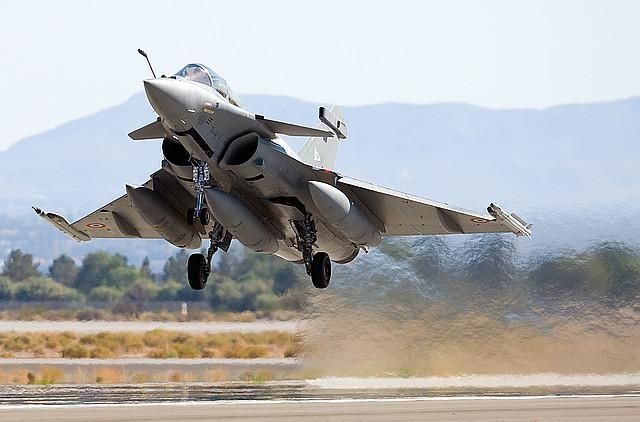
French Air Force RAFALE fighter aircraft takeoff

The next aircraft (the last one was the Gripen) being evaluated in the framework of the replacement of the Swiss F-5, is the Dassault-Aviation-manufactured RAFALE until November 7. Two two-seaters stationed at Emmen airfield – Switzerland – are being tested the same way the two Swedish Gripens were tested previously.

Latest Dassault Aviation creation, the RAFALE performed its maiden flight on July 4, 1986! Its program highlighted all the major French suppliers such as: SNECMA for the M88 engine; Thales (former Thomson – CSF) for the RBE-2 phased array radar; Dassault systems; SAGEM (electronics and optronics); and the English Messier – Dowty for the landing gear.

Unlike the Mirage 2000 which versus its American competitors, the RAFALE does not fear its opponents as far as technical performance is concerned:

  • RBE-2 phased array radar
  • Latest generation SPECTRA (electronic warfare system)
  • OSF (Front-sector optronic system)
  • a GPS (Global Positioning System)
  • last but not least: a lower cost of development and maintenance compared to the majority of its opponents…

The RAFALE has a wide range of weapons at its disposal: the infrared and radar MICA missile, the SCALP (air-to-surface cruise missile) as well as the future long-range European METEOR missile. The multirole Dassault fighter aircraft is able to be equipped with various American-made bombs: Laser-guided Paveway III, for instance, but it is a shame that foreign weapons have not been licensed for the RAFALE yet.

The RAFALE fighter aircraft are parted into three standards:

  • F1 standard: air-to-air-mission dedicated only. This standard fields the French Fleet Air Arm.
  • F2 standard: encompasses the F1 standard, and has the air-to-surface capability to its disposal. The French Air Force is fielded with these aircraft.
  • F3 standard encompasses the previous skills plus the strategic capability which enables this fighter to carry out nuclear-deterrence/strike missions, reconnaissance missions, and anti-ship-strike missions. This latter standard might field the Swiss Air Force (without the nuclear and anti-ship capabilities)

SOURCE :

AVIANEWS Article

Photos 1 & 2 French Air Force, Rafale 5/330 Squadron Côte-D’argent at Dijon.

Photo 3 Pascal Kümmerling, Rafale of the 5/330 at Geneva during BEX meeting in 2007.

Bern, 09th of October 2008 – Photo: Pascal Kümmerling – The second applicant to the replacement of the Tigers ( TTE ) landing at Emmen. The French RAFALE has already started the second TTE in-flight and ground-test series in Switzerland. The European EADS Eurofighter third and last applicant will follow in November.

About thirty flights are scheduled among which some night flights for the tests at Emmen. Around 50 sorties will be needed. They will be carried out by F/A-18s, and F-5s in order to make up the targets (means playing the role of targets) and the formation flying tests. The assessment flights occur within the frame of the flights share, which means that there should not be any increase in the number of sorties on the airfields that are concerned.

The sequel: The arrival of the European EADS Eurofighter is expected on November 6, 2008. The testing syllabus is the same for the three fighter aircraft.

The flight and ground tests will be examined as well as the tenders that were handed in on July 2nd, 2008. The collected data will be used as a basis for a second call for tenders in January 2009.

The choice of the type of aircraft should come after the evaluation of the second tender, assessing equipment and price, and when everything has been put down on a balance-sheet report expected in May 2009. Then the choice should be stated in July 2009.

These aircraft belong to the 1/7 « Provence » Fighter Squadron stationed at Saint Dizier – Robinson. The « Provence » was the first squadron that had been operational with the RAFALE. The first 1/7 RAFALE flight happened in 2006. Photos: Pascal Kümmerling.

VERY SPECIAL THANKS to Pascal Kümmerling since this post is adapted from his articles on his blog called AVIA NEWS: http://psk.blog.24heures.ch/

Facebooktwitterlinkedinmail

YVES Fusionman ROSSY, the FIRST Aviation History PIONEER of the 21st CENTURY

Yves Fusion Man Rossy smiling portrait

A few days after he succeeded in crossing the Channel, I thought it was time to show who and what gave Yves Rossy the incentive to perform such breathtaking feats. Let’s have a look at this hero’s career.

When he was a child, he said « When I am older, I will be pilots » – with an S ! This became his motto from the day he got unable to go down from a tree by himself. The child has now become « Fusionman ». In order to understand what motivated this pilot, watch and listen to Yves Rossy’s comments (in French) on the video below:

As he explained, Yves Rossy has always admired the first pioneers. Every attempt used to end by death or breakthrough. Yves Rossy has now become « Fusionman », the first man flushed in a jet-engine-propelled wing, flying as if he were Icarus.

Yves Rossy was born on the 27th of August 1959 in Neufchatel – Switzerland. Both gazing skywards, and having his feet firmly planted on the ground, he was taught technical education and passed a mechanics baccalauréat. Natural-born sportsman, he has practised everything that glides, slides, or flies – surfing, waterskiing, wakeboarding, skysurfing, parachuting, aerobatics, motorcycling, rafting, hang-gliding, etc. Flying with a jet-powered wing is the crowning of a 30-year career and numerous stunts, feats, and premieres.

FIGHTER PILOT

Certainly one of the most intense periods in his career. Yves Rossy flew the supersonic Mirage III for 15 years. During this period, he flew some historical aircraft such as the Hunter or the Venom, one of the first English jet-engine fighters. He got the idea of going round Switzerland throughout several activities within a day. He carried out this feat on the 3rd of July 1991. During his trip, he flew a DC-9, went motorcycling, skiing, snowboarding, mountaineering, paragliding, mountain-biking, bungee-jumping, he flew a helicopter, went skydiving, rafting, hydrospeeding, canoeing, drove a sportscar, went hang-gliding, horse-riding, barefooting, waterskiing, wakeboarding, and finally speedboating – that’s enough… 25 vehicles were used this day along 1,000 km for 15 hours and a half! Yves Rossy is a Swiss Air Force retiree, and keeps flying the two-seater Hunter belonging to the association Amici del Hunter. He works as a captain at Swiss Airlines, and his spare-time is dedicated to his passion. He has been supported since February 2007 by Jean-Claude BIVER, HUBLOT watches’ CEO.

HE FANCIES DOING WHAT NEVER HAPPENED BEFORE

Yves Rossy is used to venturing off the beaten tracks. He devotes all his hobbies to flight in all its forms. He multiplies the tests on contrivances that change with the passing experiments. An inflatable wing made him get over the 12-kilometer distance between the two shores of Lake Geneva. Many stunts were reported such as hang-gliding over the huge Geneva spray to surf on top of it, then land on the lake to grab a waterskiing handle, and get to the shore without getting wet! Another feat – he skydived on a disk over the Matterhorn. As Yves Rossy whished to get beyond his feats and dreams, he wanted to fly with as little instrumentation as possible – like a bird with the ability to move and steer into space, he got the idea of adding scale model jet engines under a wing.

JET-POWERED WING

The first attempt occurred in March, 2003. The German Jet-Cat company supplied the engines which were added under an inflatable wing, but this trial was a failure for lacking of rigidity. He developed a rigid spreadable carbon wing built-up at ACT Composites’ in 2004. It made an indifferent start. He spun and had to drop his wing at Al-Ain airshow. The wing parachute tore, and the device was damaged. From that time, the pilot worked hard to improve the spreading of the wing and aerodynamics at the wing tips in order to provide more stability. He achieved two flights with a two-jet-engine-propelled wing in 2005. He had a narrow shave a month later: an uncontrollable sway led him to drop his wing which crashed. After a long year and two extra jet engines added, the wing became more secure. As a matter of fact, the 5’40 » over Bex – Switzerland – came up as an awaken dream for this pioneer. Since then, Yves Rossy has relentlessly been training to optimize his wing. Yves was compelled again to drop his prototype wing while in a new test flight in April 2007. The wing was seriously damaged and took a few months to be repaired. In the aftermath of this failure, Yves Rossy decided to build up a new, more reliable, higher-performance wing. Since early 2008, his wings have become more and more sophisticated.

Finally, Yves « Fusionman » « Rocketman » « Jetman » Rossy found his place in Aviation History on the 26th of September 2008, having joined Calais – France – to Dover – England. Congratulations to Yves Rossy and thanks to MEDIA IMPACT and its staff which supplied me with materials and information to write a post about Yves Rossy.

Please visit their website at: http://www.jetman.com/

Pilot Yves Rossy flying his wing


WING SPECIFICATION SHEET

  • Wingspan: 2.50 m.
  • Central part span: 1.80 m.
  • Length of a spreadable part: 35 cm.
  • Spreading device: by gas-spring completed in half a second.
  • Weight with fuel and smoke-emission device: 55 kg.
  • Dry weight: 30 kg.
  • 4 self-started Jet-Cat P200 jet-engines (thrust: 22 kg each) – stabilized in slow-running in 25 seconds.
  • Fuel: mixed with kerosene and 5% turbine oil for lubrication
  • Rating speed: 200 km/h
  • Climb-out speed: 180 km/h (330 m/min)
  • Sink rate: 300 km/h
  • Flight endurance: 10 minutes
  • Parachute: « Parachutes de France – Legend R »
  • Canopy: PD Spectra 230
  • Harness: dropped with an automatic engine-shut-off system and, an automatic parachute opening system for proper recovery.
Facebooktwitterlinkedinmail

Effective TECHNICAL ENGLISH websites

Aviation English training Software Bewise2I must have been pretty busy last months for I’ve just realized that I haven’t added the Philip SHAWCROSS’s sites so far !!! This must be corrected right now: Mister SHAWCROSS is the author and founder of « English for aircraft ».

English for aircraft book cover

His two books make up undoubtedly the cleverest way of teaching technical English, especially for ESOL students. His renowned software « Docwise » is a must for the engineers and mechanics desiring to be trained as far as technical English and aeronautics are concerned. Click on the logo on your left handside to visit « Bwise2 », his website dedicated to aviation English language training for mechanics and pilots. Bwise2 can provide everything you need to learn technical English within the scope of aeronautics.

Bwise2 is not his only asset. Philip SHAWCROSS is the president of the International Civil Aviation English Association – ICAEA – a non profit-making association created under the 1901 French law.

English for aircraft logo

ICAEA’s aims:

To bring together people and organizations concerned by or interested in the use of English in the aviation and aeronautical world.

To promote the exchange of information as regards English, English training, standards, qualifications, translation, documents etc, between people working within aviation in different countries.

To centralise information useful to the Airlines, Authorities, Air Traffic Services, manufacturers, pilots, engineers, universities, research institutes, training centers and teachers.

To enhance the circulation of this information through a web site, a list serve, seminars and the publication of their proceedings.

Finally, to generate concern about the quality of English in the aviation world. Please click on the logo hereafter to visit the ICAEA website:

ICAEA logo

Facebooktwitterlinkedinmail

FRENCH AIR FORCE BASES TO CLOSE DOWN:

The French Prime minister François Fillon has addressed an official statement this morning:

After the reform, “The French Army will have shed 20 Regiments/Batallions”, The Air Force will have shed 11 Air Bases,and the Navy will have shed “a Fleet Air Arm Base”.

The units or sites concerned are small, medium, and large ones – from tens of people up to 2,502 people as far as Metz AF Base is concerned.

  • As early as 2009, the French government plans the closing down of the AF Base 101 stationed at Toulouse.
  • In2010 Colmar-Meyenheim (Haut-Rhin) AF Base 132 should close down (1,276 people).
  • From 2011 -2012, Nîmes Garons Fleet Air Arm Base (1,332 people) will close down, as will the AF Base 112 stationed at Reims (1,545 people), and Taverny Air Base (Val-d’Oise, 986 people) as well. The AF Base 128 (Metz-Frescaty, Moselle, 2.502 people), AF Base 103 of Cambrai-Haynecourt (Nord, 1,364 people), AF Base 217 at Bretigny-sur-Orge (Essonne, 1,955 people). Overseas AF Bases: 365 Lamentin (650 people) in Martinique in the French West Indies, and overseas AF Bases 190 Papeete – Faa’a (Tahiti), in Polynesia (920 people), and AFB 181 Sainte-Clothilde, La Réunion. The radar Air Force Base 943 Nice Mont-Agel is to be shed too.

While 83 military sites will close down, it is deemed that around 60 sites will be operationally-meant reinforced. Evreux (Eure) Air Force Base 105 is expected to get a reinforcement up to 800 people.

The French government plans 54,000 jobs to be axed in the Armed Forces and Defense within a seven-year period. The current France strength is 320,000 (without the Gendarmerie). The French Air Force should reach down to 50,000 strength.


Facebooktwitterlinkedinmail